
Dinamo #3 - Climate Economics (Part 1)
Today's Contents
- Perspective
- Brand New Inc.!
- Live cases
- Keys to the context
- Voices
For years we imagined climate change like the world of the film Interstellar: dust storms, failed harvests, a planet becoming uninhabitable in a distant future.
But we haven't needed to go that far. Climate phenomena, with their chaotic and heterogeneous nature, already show us in the present a complex form of transformation of our economy and society — one that plays out daily: in the electricity bill, in home insurance premiums, in planning where to spend the summer, in the flows of climate refugees we confuse with migration, in the price of wheat, in the cost of capital, and even in the operational viability of the data centers that underpin the digital economy.
CO2 levels, degrees, and 2050 deadlines remain necessary measures, but they are no longer sufficient to understand what is happening. Citizens' and businesses' conception of climate change has been shaped by listening to negotiations between countries over accepting one more or one less degree, or by images of a polar bear on a melting iceberg — we have not sufficiently perceived the economic security dimension of all this.
That is why we are opening this new series, Climate Economics, to explore that shift: from climate as an environmental problem to climate as a first-order economic and security variable.
And we begin where it is already fully visible: energy.
Perspective
The current debate focuses heavily on the competitive advantage held by countries that are prioritizing a new energy governance model, amid ongoing market tensions driven by conflicts, particularly in Iran and Ukraine.
It is worth examining Spain's situation more closely and testing our own thesis: to what extent is the country actually benefiting from its energy model? The question we want to investigate is whether the competitiveness of producing clean, cheap energy (a real phenomenon in Spain) actually translates through to end users.
Three bottlenecks
There are three main bottlenecks to consider:
- Electrification of demand. In a model where renewable energy generation is dominant, this requires CAPEX, financing, and speed in replacing the existing stock of gas- and diesel-powered installations. What is the situation for individuals and businesses in Spain right now? Are they in a position to make these investments? The data invites optimism: according to the EIB Investment Survey (EIBIS 2025), Spanish companies have more ambitious climate targets than the European average, invest more in energy efficiency, and perceive access to financing as easier. The challenge, more than willingness, is pace and scale: the upfront outlay continues to weigh on SMEs and households, who are the slowest to replace their existing equipment.
- The "cannibalization effect" of renewables. As described in the previous edition, wholesale prices in Spain are very low. These price levels can erode generator revenues and require support mechanisms to make investment worthwhile. Why? Because electricity prices are set hour by hour, and solar production is concentrated in the cheap hours (midday), when there is so much supply that prices collapse and even turn negative (in April 2026 alone, Spain recorded 138 hours of negative prices), forcing solar farms to pay to feed energy into the grid. In contrast, in the afternoon and at night, when the sun is no longer producing, the price is set by gas (pushed up by the Iran war) or by hydropower when reservoirs are full. The underlying problem is that solar producers do not capture the average price of the day, but rather the price during the hours they produce: according to UNEF, the price captured by photovoltaic fell from €76.1/MWh in February 2025 to just €2.0/MWh a year later.
- The wholesale price is not the final bill. The bill includes additional elements such as tolls, charges (including premiums for older renewables, tariff deficits, etc.) and taxes. Today, according to OCU, the weight of these elements is considerable: tolls and charges alone account for 40% of the electricity bill (and more when taxes are included). Following the blackout of April 2025, a reinforced operating mode was introduced to ensure system security, and the cost of balancing services reached a record in March (€0.0388/kWh).
Spain has wholesale prices that remain among the lowest in Europe, but this data demonstrates three things:
- This advantage is volatile and depends on gas and hydro availability (the pool went from €16.92/MWh in May 2025 to €54/MWh a year later — more than triple).
- It does not translate cleanly into investment, because cannibalization is hollowing out the revenues of renewable generators themselves.
- It coexists with a final bill where 40% consists of regulated costs paid by all citizens.
A real but conditional advantage
Our thesis of Spain as an economy with structurally low energy costs is valid in certain contexts, but runs up against the fact that two of the variables that set the price are exogenous and volatile, deriving from transition or physical risks related to climate change: the price of gas (driven by geopolitics) and rainfall levels (exposed to climate risks). Spain controls neither of these. In this context, it is worth being precise about what would truly make Spain's advantage structural:
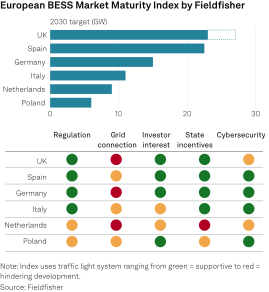
- Storage. Breaking our dependence on gas during peak hours can only be achieved through storage (batteries, pumped-hydro) that shifts cheap midday energy to the evening. This is where the advantage could become structural: batteries counter the main argument against renewables — their intermittency and the need to maintain a gas backup — because they allow surplus midday solar to be stored and used when the sun is no longer producing, smoothing exactly the hours when gas currently drives up prices. If Spain, which already generates abundant renewable energy, were to add a powerful layer of storage and optimize it with advanced technologies (e.g. AI to forecast and manage demand, quantum computing to optimize dispatch and capacity placement), the advantage would cease to be cyclical (dependent on sunshine and full reservoirs) and become structural: a system capable of capturing the low price and sustaining it 24 hours a day.
- CAPEX financing. Long-term financing schemes to fund capital expenditure with the savings generated over time (which is very difficult due to the misalignment of incentives between tenant and landlord: when the one who pays for the investment is not the one who pays the bill).
- Regulated costs. Part of the additional charges on bills stem from historically expensive renewable premiums that will gradually expire, so we can be cautiously optimistic that the regulated portion will be structurally lower in the future.
The battle over the narrative
The central question — how to ease the bill right now when these costs cannot be compressed (as the blackout demonstrated) — is a political decision: who should bear the legacy of the system and of energy policy? Will it be the electricity user (the current model), or the citizenry and businesses collectively through general taxation (where those with more pay more)? This is not a technical matter, but a collective choice. And this choice faces a risk: the quality of the information on which it is based. Those who stand to lose most from the transition — incumbents of the fossil model — have a clear incentive to slow it, and the most effective way to do so is not open debate, but muddying the waters: sowing doubts about the real cost of renewables, blaming them for blackouts, presenting fossil dependency as stability. Historian Nils Gilman describes in Foreign Policy an emerging "eco-ideological Cold War" between a green bloc led by China and an axis of petrostates — the US, Russia, and Saudi Arabia — who see decarbonization as an existential threat to their model.
The risk, therefore, is not only technical or financial: it is that the battle is fought on the ideological and disinformation plane, both inside and outside our borders, and that decisions are taken on the basis of a distorted diagnosis.
Despite this context, public support for the transition remains majority (81% according to Eurostat in 2025). The challenge, as a recent ECFR report argues, is to translate that support into policy with real benefits for society — moving away from framing decarbonization as sacrifice and austerity, and instead presenting it as a project of sovereignty and prosperity. The ECFR goes as far as to suggest that the divide between fossil and electric will be one of the great political fault lines of the coming decades, as the divide between labor and capital once was. Understanding these numbers clearly — where prices come from, who pays what, what would make the advantage structural — is not a theoretical exercise: it is the prerequisite for making informed decisions.
Brand New Inc.
The risks of the transition (and of not making it)
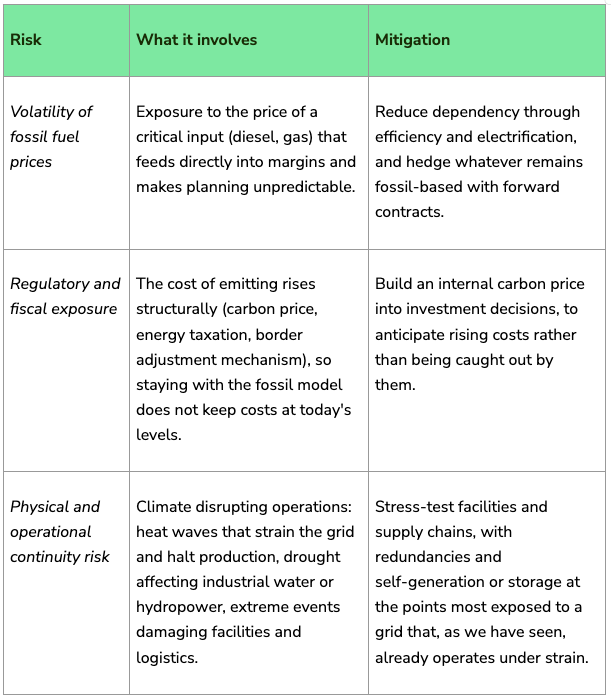
If the complexity at the macro level is real, it is no less so at the business level. In a context of market tension, the transition is having direct impacts on company income statements, and understanding these impacts is essential for better informing short- and long-term decisions. We group them into two families — the risks of inaction and the risks of transition — because neither is avoidable. The tables below summarize each risk and how to mitigate it.
Risks of inaction (staying with the fossil model):
Risks of transition (moving toward the clean model):
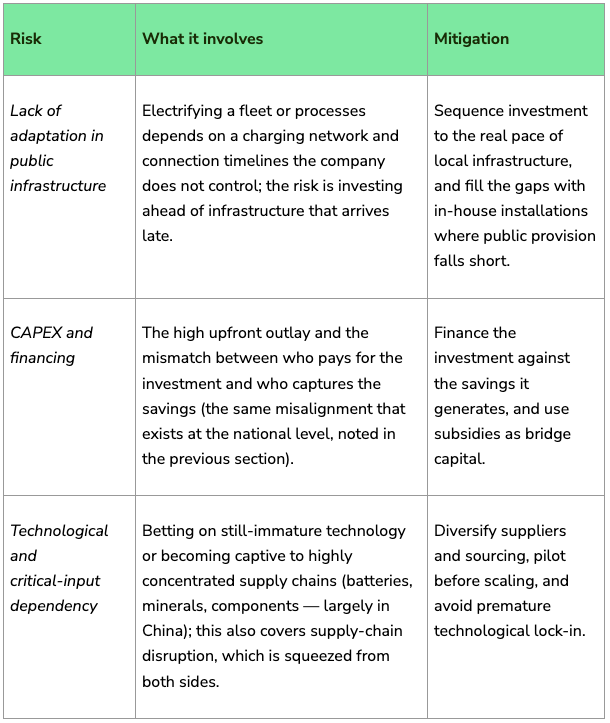
Neither family is avoidable, and inaction is not the safe option it appears to be. The job for companies is therefore not to choose between taking risk or not, but to quantify both exposures and decide on the pace of their transition with sound judgment.
What does the best-positioned company for this look like? Atomico's latest State of European Tech offers a clue, positioning the climate transition as one of three "once-in-a-century" transformations of the European ecosystem (alongside AI and health) — one that "will define the competitiveness of our economies for generations." It is not a parallel agenda: 18% of European venture capital went to climate and energy in 2025, the third largest investment category. And an angle where Europe may lead is emerging: sustainable AI — more efficient models with a lower energy footprint by design — which turns Europe's situation (decarbonization commitments, regulatory pressure) into a value proposition. The company of the future, in this framework, is not one that chooses between going digital and decarbonizing, but one that understands these are the same lever: it uses technology to manage its energy exposure, and treats efficiency (in electrons and in compute) as a competitive advantage, not a compliance cost.
Live cases
Projects in progress and companies from the Dinamo ecosystem.
#The first climate seal for digital companies with Adigital. Adigital has launched the Digitalización Sostenible (Sustainable Digitalization) seal — the first climate certification designed specifically for digital economy companies in Spain — supported by CO2pilot, a Dinamo AI-powered tool that automates emissions calculation and management, adapted to a sector whose emission sources differ from those of traditional industry. For a digital company, the carbon footprint is above all a question of energy (electricity consumption of data centers, cloud, and computing), so measuring and reducing it requires managing how much electricity is consumed and from what source. The transition enters these companies through the demand side — and precisely in the sector whose appetite for electricity is growing fastest.
#Quantum optimization for the transition with Multiverse Computing. The Spanish company Multiverse Computing applies AI and quantum-inspired optimization to several fronts of the energy transition. Its technology optimizes the integration of renewables into the grid and the placement of batteries, addresses storage and system flexibility (the bottleneck in a majority-renewable model), and designs digital twins to reduce the cost of green hydrogen production. In parallel, its CompactifAI tool compresses language models by up to 95% and cuts their energy consumption by up to 75% without loss of accuracy (according to the company), enabling AI to run locally with a much smaller footprint.
#Mitiga Solutions: climate risk converted into data. Barcelona-based Mitiga Solutions, a spin-off of the Barcelona Supercomputing Center, won South Summit Madrid 2026. Its EarthScan platform translates climate science into quantified physical risk exposure (heat waves, droughts, wildfires, extreme events) through supercomputing and risk models. Today, part of that risk falls on the electricity system: the heat waves that stress the grid and the droughts that reduce hydroelectric generation are precisely the variables that make prices volatile. Where one side looks at energy supply, Mitiga quantifies the physical risk that threatens it, and converts it into a number companies can act on. In May, they published a highly valuable report on the climate risk gap for businesses in Spain.

Source: Reimagining Museums for Climate Action / Studio JZ.
Keys to the context
Reference briefs for understanding the energy transition as an economic variable and the risks it brings.
1️⃣ Iran shock accelerates EV purchases (Bloomberg) — The Iran war and rising crude prices are accelerating electric vehicle sales across much of the world: in the first month after the start of the bombardments, France, Germany, and the UK registered 206,200 electric vehicles — 44% more than a year earlier — and in Italy sales grew 67%; the IEA forecasts EVs will reach nearly 30% of global car sales in 2026.
2️⃣ Carney wants to double Canada's electricity generation (Bloomberg) — Prime Minister Mark Carney has presented a national strategy to double Canada's electricity generation by 2050, with grid expansion costs projected to exceed one trillion Canadian dollars, split among the federal government, provinces, and the private sector.
3️⃣ The EU's digitalization and AI roadmap for energy (European Commission) — Published June 2, 2026, the roadmap seeks to accelerate the deployment of digital and AI solutions in key decarbonization areas, such as grid optimization, energy efficiency in buildings and industry, and demand flexibility, while addressing the growing energy consumption of data centers and how to integrate them more sustainably.
4️⃣ Grids and flexibility: the new bottleneck of the electricity system (IEA) — The report focuses on grids and flexibility as the great challenge of this phase: more than 2,500 GW of renewable, storage, and large-consumer projects are stuck in grid connection queues worldwide, and annual investment in grids needs to rise around 50% by 2030 from the current approximately $400 billion.
5️⃣ The battery revolution is beginning to lower bills (The Guardian) — A report on how domestic and industrial storage is changing the economics of renewables: batteries allow midday solar to be stored and released when prices rise, countering the old intermittency argument. Australia's case is the most advanced (third in the world in new capacity, connections doubled in a year), and the result is already measurable: cheaper grid electricity.
Voices
"The path to affordability is electrification; the path to competitiveness is electrification; the path to net zero is electrification."
— Mark Carney, Prime Minister of Canada (2026)